

IELTS International English Language Testing System
IELTS Preparation
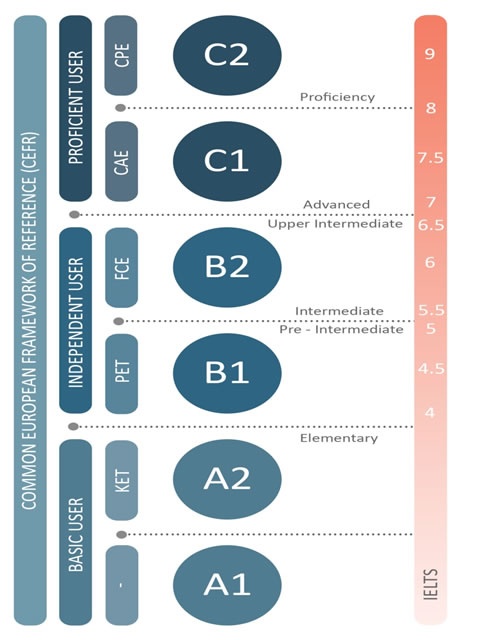
IELTS is an English language exam for those who want to study or work in countries where English language is an official language of communication. It uses a nine-band scale to clearly identify levels of proficiency, from non-user (band score 1) through to expert (band score 9).
A great number of organisations around the world accept the IELTS certificate for different purposes, such as immigration, studies, employment, professional training and participating in training programmes.
Many of the registration bodies which accept IELTS represent the healthcare professions, such as nursing, medicine and pharmacy. Other professional bodies, in particular countries requiring an IELTS result, include accounting, engineering, law and veterinary practice. A wide range of other employers from sectors such as finance, government, construction, energy, aviation and tourism also require IELTS.
Passing the IELTS test will open up many opportunities for you when it comes to international education and employment around the world. Also important is that universities and employers recognise candidates who get higher marks in the exam.
The IELTS test is a clear indicator of your English language knowledge and can guarantee that candidates with specific grades have shown the ability to communicate sufficiently in English language through all four language skills – reading, writing, listening and speaking.
WORLDWIDE RECOGNITION
IELTS is accepted by over 10,000 organisations in more than 140 countries. These include:
- universities, schools, colleges and training organisations
- government departments and immigration authorities
- professional and industry associations
- multinational companies and employers
TEST STRUCTURE
IELTS has two modules, that is, two versions of the exam:
The Academic Module is for those who want to study at a university abroad. The exam determines whether the candidate is ready to attend undergraduate or post-graduate studies in English. Many universities in Great Britain, the United States and other countries require that students, who come from other countries, have an IELTS certificate Academic Module.
The General Training Module is designed for students who wish to complete their high-school education in an English-speaking country, as well as for candidates who wish to take part in staff training programmes, work in or emigrate to other countries, such as Australia, Canada, New Zealand and the United Kingdom, where English is the mother tongue.
The test consists of four parts which cover all language skills: listening, reading, writing and speaking.
For more detailed information see the IELTS handbook:
contact us about this course.
Copyright © 2023 Owen Owen Languages UK. All rights reserved.
TEST YOUR ENGLISH